
From Amyloid to Tissue Permissiveness in Alzheimer’s Disease
When the Brain Can No Longer Keep Up
For decades, Alzheimer’s disease has largely been told as a molecular story: amyloid-β accumulates, Tau pathology follows, neurons degenerate, and cognition declines.
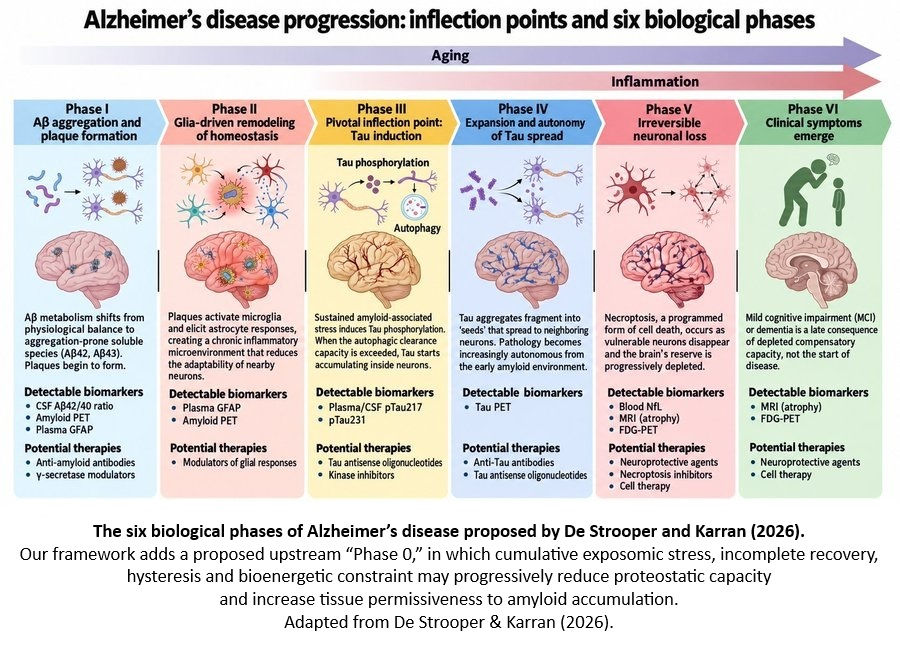
A new Nature review by Bart De Strooper and Eric Karran proposes a more dynamic picture. Rather than treating Alzheimer’s disease as a uniform linear cascade, they argue that the disease unfolds through distinct biological phases separated by inflection points. At these thresholds, stressed tissue loses homeostatic control and enters a qualitatively different state. Different parts of the same brain can cross these thresholds at different times, creating a mosaic of relatively resilient and progressively pathological tissue domains.
This is an important conceptual advance. But it also raises an even deeper question:
What makes a tissue domain cross the threshold in the first place?
That question may require us to look upstream of amyloid—toward the cumulative energetic cost of adaptation, incomplete recovery, and the progressive loss of the capacity to maintain cellular order.
Alzheimer’s disease as a series of biological transitions
De Strooper and Karran divide Alzheimer’s disease into a series of phases.
The process begins with a change from physiological amyloid-β metabolism toward accumulation of longer, more aggregation-prone Aβ species. Production, clearance, cellular handling and nucleation all matter. Importantly, the authors describe early Aβ accumulation as a dynamic process that may remain reversible while production, uptake and clearance stay in balance. The first major inflection point occurs when that homeostatic control fails.
Established amyloid plaques then reorganize their cellular surroundings. Microglia and astrocytes enter coordinated stress and inflammatory states. These responses may initially help contain pathology, but persistent activation changes the local environment and progressively reduces neuronal adaptive capacity.
A particularly important transition occurs when this amyloid-associated environment induces changes in Tau. Tau phosphorylation may initially be part of a reversible stress response. But when phosphorylation persists and proteostatic clearance becomes insufficient, phosphorylated Tau accumulates and tissue becomes permissive for Tau nucleation.
Once Tau seeds form, another transition occurs. Fragmentation, secondary nucleation and cell-to-cell propagation allow Tau pathology to become increasingly self-amplifying and progressively less dependent on the amyloid environment that initially helped create it.
Eventually, potentially reversible dysfunction crosses into irreversible neuronal injury and loss. Clinical symptoms appear relatively late, when accumulated neuronal loss overwhelms network redundancy and compensatory reserve.
This is already a major departure from a simple amyloid cascade.
But perhaps the most interesting concept in the review is not amyloid or Tau at all.
It is permissiveness.
Why does one tissue become permissive while another remains resilient?
The authors repeatedly emphasize that apparently similar tissue domains do not necessarily behave similarly.
Some brains tolerate substantial amyloid pathology without major cognitive impairment. Within the same brain, one region may remain dominated by relatively contained amyloid pathology while another has progressed to Tau propagation and neuronal loss.
The authors therefore identify resilience and vulnerability as biological properties that determine where the thresholds between phases lie. Ageing may lower these thresholds by eroding proteostatic, mitochondrial, vascular and immune reserves. Yet ageing is not deterministic: some people remain cognitively resilient despite substantial neuropathological burden.
This leaves a fundamental problem.
Why does proteostatic capacity decline?
Why does one cell continue to handle Aβ while another begins to accumulate it?
Why can one neuron resolve Tau phosphorylation while another enters an aggregation-permissive state?
Calling the first tissue “resilient” and the second “vulnerable” describes the difference, but does not completely explain it.
A broader systems framework may help.
Proteostasis is work
Cells do not maintain themselves passively.
Proteostasis requires continuous expenditure: proteins must be folded, refolded, trafficked, repaired and degraded. Autophagosomes must form and move. Lysosomes must remain acidified. Membranes must be recycled. Damaged organelles must be removed and replaced. Ionic gradients must be maintained. New proteins must be synthesized.
All of this requires energy, substrates, reducing capacity, cellular machinery and time.
This means that proteostatic capacity cannot be separated from bioenergetic capacity.
The Nature review recognizes impaired clearance and endolysosomal handling as contributors to Aβ accumulation and later identifies declining proteostatic and mitochondrial reserves as factors affecting disease thresholds.
But an important question remains one step upstream:
What if proteostatic failure occurs partly because persistent stress makes the energetic cost of maintaining proteostasis progressively harder to sustain?
This possibility opens a different way of thinking about Alzheimer’s disease.
From exposome to unresolved recovery
Every organism lives within an exposome: the cumulative biological consequences of diet, pollutants, infections, physical activity, sleep, psychosocial stress, medications, metabolic conditions and many other environmental and internal demands.
Most individual stressors do not necessarily cause disease. Healthy systems respond, adapt and then recover.
The crucial distinction may therefore not be simply between exposed and unexposed, but between:
stress that resolves
and
stress that leaves something behind.
Consider a simple sequence:
stress → adaptation → recovery
When recovery is complete, the system returns close to its previous operating state.
But repeated or prolonged stress may instead produce:
stress → adaptation → incomplete recovery → residual displacement
The next challenge now begins from a slightly altered baseline.
Repeated often enough:
adaptation → incomplete resolution → adaptation → incomplete resolution
can progressively generate a backlog of unfinished biological work: damaged proteins, altered organelles, inflammatory activity, metabolic displacement, repair demands and regulatory changes that have not completely returned to baseline.
Hysteresis: when biological history begins to matter
This is where hysteresis becomes useful.
A system showing hysteresis does not respond only according to its present input. Its present state also depends on the path it took to get there.
Two cells facing the same current challenge may therefore respond differently because their histories are different.
One may have repeatedly recovered completely.
The other may carry years of residual adaptive burden.
The same Aβ production rate could consequently be manageable for one cell but excessive for another.
The pathological threshold would no longer be a fixed number. It would become history-dependent.
This gives tissue permissiveness a temporal dimension:
past unresolved adaptation changes the response to the next stressor.
Allostatic load and allostatic triage
Persistent adaptation also creates an allocation problem.
Biological resources are finite. Under increasing demand, a cell—or an organism—cannot maximize every function simultaneously.
Immediate priorities such as maintaining membrane potentials, inflammatory defence, stress signalling, circulation and essential cellular function may have to compete with slower maintenance activities such as repair, protein turnover and long-term restoration.
This can be viewed as allostatic triage.
The issue is not necessarily that maintenance machinery suddenly breaks. Instead, acute adaptation may progressively take priority over complete restoration.
The cell continues functioning.
But it begins accumulating unfinished maintenance.
That distinction matters enormously.
A tissue can therefore look compensated while simultaneously losing reserve.
Bioenergetic impedance and the throughput problem
This brings us to bioenergetic impedance.
A cell may still produce ATP and yet experience increasing difficulty moving energy substrates, reducing equivalents, metabolites and usable energetic flux through the system at the rate demanded by its total workload.
The important variable is therefore not simply ATP concentration.
It is throughput relative to demand.
As adaptive work accumulates, energetic throughput must simultaneously support:
normal cellular function + stress response + inflammation + repair + proteostasis + organelle turnover + recovery.
Eventually, total demand may approach sustainable throughput.
At that point, the problem becomes one of allocation.
Something must be deferred.
And proteostatic maintenance may become one of the casualties.
A hypothetical sequence therefore emerges:
Exposome→ repeated allostatic responses→ incomplete resolution→ hysteresis and biological backlog→ increasing allostatic load→ resource triage→ bioenergetic impedance→ throughput limitation→ incomplete repair and proteostasis→ tissue permissiveness
This is not yet an established causal pathway in Alzheimer’s disease. It is a systems hypothesis.
But it provides a possible answer to a question that the inflection-point model leaves open:
Why does homeostatic control eventually fail?
Amyloid accumulation may reflect a capacity–demand mismatch
This perspective also changes how amyloid accumulation can be viewed.
Amyloid burden is often conceptualized mainly from the production side: APP processing, Aβ42/Aβ43 generation, nucleation and aggregation.
But accumulation always represents a balance:
Aβ generation and aggregation pressure versus Aβ handling and clearance capacity.
De Strooper and Karran themselves emphasize this dynamic equilibrium.
If clearance is energetically and proteostatically demanding, then chronic bioenergetic stress could shift that balance even without dramatically increasing Aβ production.
The relevant progression might therefore be:
persistent stress→ increasing energetic workload→ declining maintenance throughput→ impaired Aβ trafficking/degradation/clearance→ Aβ accumulation
Amyloid would then be not merely an initiating lesion, but in part a manifestation of declining homeostatic handling capacity.
Once established, however, amyloid would become an additional stressor.
Amyloid activates glial responses. Glial activation increases inflammatory and metabolic demand. That additional demand further strains energetic and proteostatic systems.
A feedback loop becomes possible:
bioenergetic stress→ impaired Aβ handling→ amyloid accumulation→ glial activation→ additional energetic demand→ further bioenergetic impedance→ further proteostatic impairment
Amyloid could therefore be both consequence and amplifier.
That is very different from saying that amyloid is irrelevant. It remains biologically important. But it is placed inside a larger adaptive system.
Tissue permissiveness may be the missing bridge
The concept of tissue permissiveness becomes especially powerful in this framework.
A pathological molecule does not operate in isolation.
Its consequences depend on the state of the tissue receiving it.
A high-reserve tissue may have sufficient energetic and proteostatic capacity to contain Aβ, remove damaged proteins and restore homeostasis.
A tissue carrying a large unresolved backlog may not.
Its threshold has effectively moved.
The same principle could apply to the amyloid–Tau transition.
The review proposes that persistent Tau phosphorylation combined with inadequate clearance creates an aggregation-permissive state. s41586-026-11110-5_reference
The deeper question becomes:
Why did clearance become inadequate in that neuron at that particular moment?
A throughput model suggests that the answer might involve the cumulative relationship between adaptive demand and remaining maintenance capacity.
Thus:
bioenergetic stress → proteostatic constraint → Tau persistence → tissue permissiveness → nucleation
rather than simply:
amyloid → Tau.
A different centre of gravity for Alzheimer’s research
This would shift Alzheimer’s disease research away from choosing between competing single causes.
The question would no longer be:
Is Alzheimer’s primarily amyloid, Tau, inflammation or mitochondrial dysfunction?
Instead:
What determines whether the brain can continue to absorb, compensate for and recover from these stresses before they become self-sustaining?
That moves the centre of gravity from a lesion-centred model toward a systems-capacity model.
Amyloid, Tau, inflammation, vascular dysfunction, mitochondrial impairment and proteostatic failure may then represent interacting components of a system progressively losing its ability to recover.
What should future Alzheimer’s research test?
This larger framework generates several testable directions.
First, research should move beyond measuring pathological burden alone and begin measuring recovery dynamics. After standardized metabolic, inflammatory, cognitive or physiological challenges, do individuals return rapidly toward baseline—or show delayed recovery and persistent displacement?
Second, we need better measures of bioenergetic throughput, rather than relying only on static mitochondrial markers. The relevant question is whether energetic systems can meet changing demand while continuing to fund repair and maintenance.
Third, studies should examine whether declining proteostatic capacity is predicted by prior energetic stress and incomplete recovery. Longitudinal integration of mitochondrial function, autophagic flux, inflammatory activation, vascular supply and protein-clearance markers could be especially informative.
Fourth, the field could investigate biological backlog directly: whether accumulated unresolved cellular work predicts later amyloid or Tau permissiveness better than individual exposures considered separately.
Fifth, spatial studies become especially important. The Nature review already argues that different brain regions occupy different biological phases simultaneously.
Comparing high- and low-permissiveness tissue domains within the same brain could reveal whether energetic reserve, proteostatic capacity, glial state and vascular support distinguish the regions that progress from those that remain stable.
And finally, prevention research should move further upstream.
Instead of asking only how to remove amyloid after it forms, we should also ask:
How can we preserve the tissue state in which amyloid remains manageable?
From removing pathology to preserving recoverability
The therapeutic implications could be substantial.
Amyloid-directed therapy may remain valuable, particularly when amyloid-dependent states are still modifiable. The review itself argues that therapeutic effectiveness depends strongly on which inflection points have already been crossed.
But a broader strategy would combine reducing pathological burden with preserving or restoring the biological capacity that prevented the burden from becoming pathological in the first place.
That means considering not only:
Can we remove amyloid?
but also:
Can we reduce cumulative stress?Can we improve energetic throughput?Can we restore proteostatic reserve?Can we improve recovery?Can we move tissue away from a permissive state before the next inflection point is crossed?
The ultimate goal may therefore be larger than preventing protein accumulation.
It may be preserving recoverability.
De Strooper and Karran end their review by arguing that the goal should not merely be to determine disease stage, but to identify which biological transitions can still be prevented, delayed or reversed.
The next question may be even more fundamental:
What allows a biological system to remain reversible in the first place?
A framework connecting exposome → unresolved adaptation → hysteresis and backlog → allostatic triage → bioenergetic impedance → throughput limitation → proteostatic failure → amyloid accumulation → tissue permissiveness offers one possible path toward answering it.
If that framework proves correct, Alzheimer’s disease may need to be understood not only as a disease of abnormal proteins, but as a disease in which decades of accumulated adaptive work progressively make normal cellular maintenance too difficult to sustain.
And the most important intervention point may occur long before the brain has crossed the threshold from stress that can still be resolved to pathology that has learned to sustain itself.
De Strooper, B., & Karran, E. (2026). Inflection points and transitions in Alzheimer’s disease. Nature. Advance online publication. https://doi.org/10.1038/s41586-026-11110-5


Comments