
Turning Up the Heat: What Exercise, Cold, and Metabolism Teach Us About Energy, Aging, and Disease
For years, we’ve been told that improving metabolic health is mostly about one thing:
Eat less. Lose weight.
But what if that’s only part of the story?
A fascinating scientific review—“Combatting type 2 diabetes by turning up the heat”—
points us in a different direction.
Instead of focusing only on how much energy we store, it highlights something more fundamental:
How well our body can process and use energy.
And this idea aligns remarkably well with a concept I’ve been developing called Exposure-Related Malnutrition (ERM)—particularly the role of mitochondrial mechanics.
Let’s unpack this.
The Key Insight: It’s Not Just About Calories—It’s About Flow
The review shows something surprising:
Exercise improves insulin sensitivity
Cold exposure improves insulin sensitivity
Even small increases in activity improve metabolic health
And here’s the critical part:
These benefits often happen without significant weight loss.
So if weight isn’t changing much…
What is actually improving?
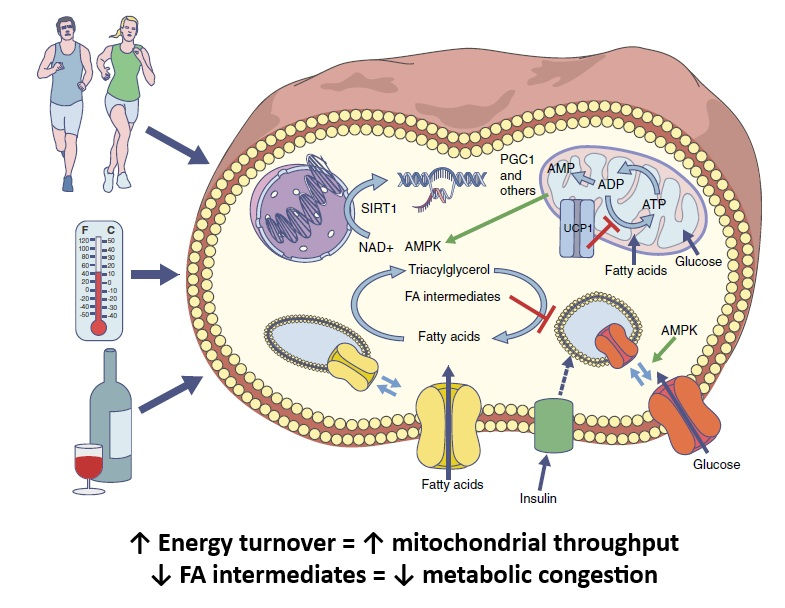
The Missing Piece: Energy Turnover
The authors introduce a powerful concept:
“Energy turnover”
This refers to how actively your body is:
Burning fuel
Cycling nutrients
Producing and using energy
Think of your body like a city:
Energy = money
Mitochondria = power plants
Metabolism = traffic flow
You don’t get problems just because there’s money in the system…
You get problems when traffic stops moving.
ERM Perspective: When the System Gets Congested
This is exactly where ERM mitochondrial mechanics comes in.
According to this framework:
Your mitochondria have a limited capacity to process energy
When energy supply exceeds that capacity, a backlog forms
This creates what we call:
Mitochondrial congestion
At the cellular level, this looks like:
Build-up of reducing equivalents (like NADH)
Slower energy production
Accumulation of metabolic intermediates
And clinically?
It shows up as:
Insulin resistance
Fatigue
Fat accumulation
Muscle loss
Why Exercise and Cold Work (Even Without Weight Loss)
The review highlights two powerful interventions:
1. Exercise
2. Cold exposure
At first glance, they seem very different.
But under the hood, they do something very similar:
They force the body to increase energy flow
Exercise: Increasing Demand
When you move:
Muscles demand more ATP
Mitochondria are pushed to work harder
Energy flow increases
This helps clear the backlog
Cold Exposure: Forcing Heat Production
When you're exposed to cold:
Your body must generate heat
It burns both fat and glucose
Energy turnover rises
Again, the system is forced to process more fuel
A Crucial Insight: It’s Not About Burning Fat—It’s About Processing It
One of the most important findings in the review is something called:
The “athlete’s paradox”
Highly trained athletes can have:
High fat inside their muscles
But excellent insulin sensitivity
Why?
Because:
Their system keeps fuel moving
Why This Matters at the Population Level
This is where the review becomes especially powerful.
It doesn’t just show mechanisms in a lab.
It shows that:
Across different people
Across different ages
Across different conditions (including diabetes)
Increasing energy turnover consistently improves metabolic health
And importantly:
Even small, realistic changes (like moving more or mild cold exposure) have measurable effects
This is what we call “population-level support”
It means:
This isn’t just a theory that works in controlled experiments.
It works:
In real people
In real life
Across diverse conditions
ERM Interpretation: A Deeper Unifying Principle
From the ERM perspective, all of this points to a deeper truth:
Metabolic disease is not just about excess—it’s about impaired processing.
Or more simply:
You’re not overloaded…You’re congested.
Putting It All Together
The review shows:
Exercise → improves metabolism
Cold → improves metabolism
Increased energy turnover → improves metabolism
ERM explains why:
Because these interventions restore mitochondrial throughput—the body’s ability to process energy efficiently.
A New Way to Think About Health
This shifts the conversation:
From:“Just reduce calories”
To:“Improve how your body handles energy”
Final Thought
If you’ve been struggling with fatigue, weight, or metabolic issues…
It may not mean your body is broken.
It may mean your system is overloaded and underpowered at the same time.
And the path forward isn’t just restriction—
It’s restoring flow.
Reference
Schrauwen, P., & van Marken Lichtenbelt, W. D. (2016).Combatting type 2 diabetes by turning up the heat. Diabetologia, 59(11), 2269–2279. https://doi.org/10.1007/s00125-016-4068-3


Comments