
⚡ Life’s Hidden Rhythm: How Energy, Stress, and Recovery Keep Every Cell in Time
- Healing_ Passion
- Oct 9, 2025
- 3 min read

Updated: Oct 16, 2025
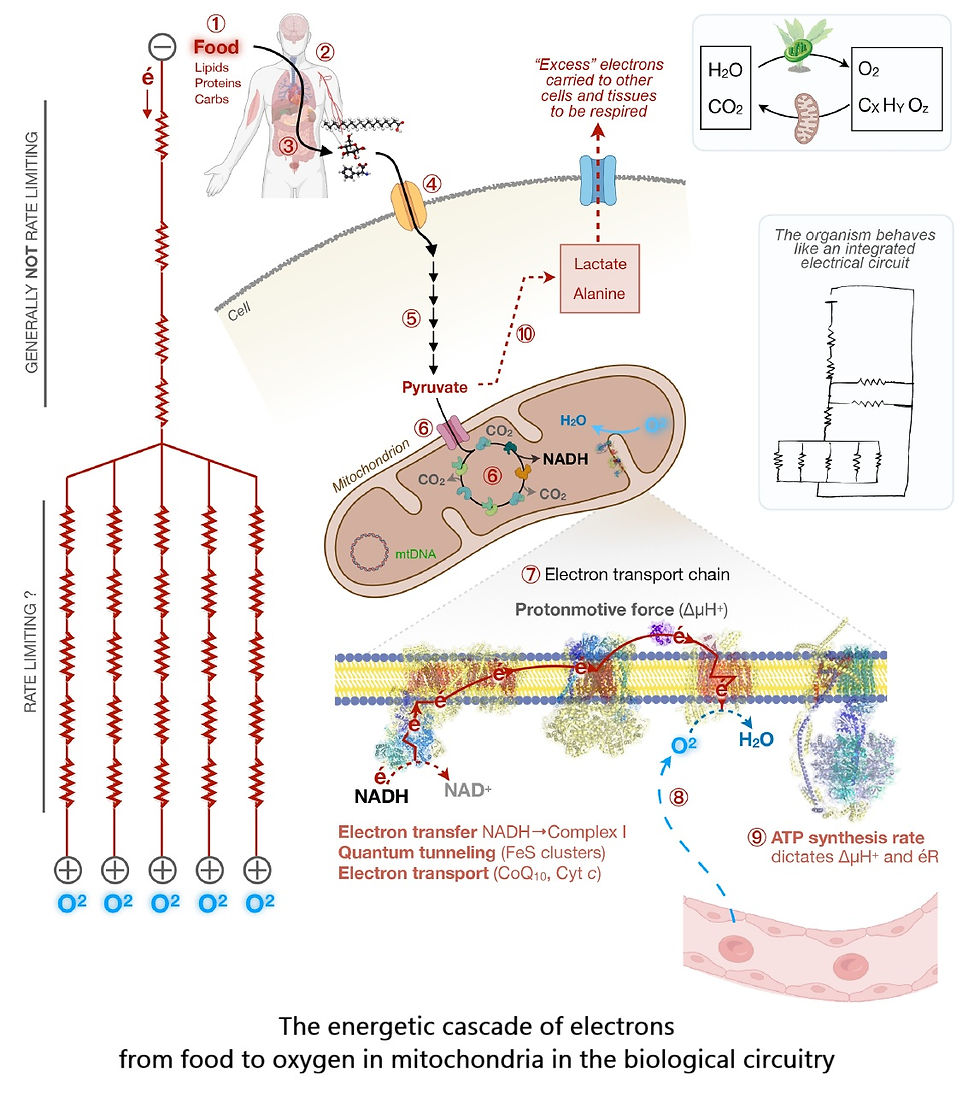
In 2025, Martin Picard and Ramaswamy Murugan published a groundbreaking perspective in Cell Metabolism introducing the Energy Resistance Principle (ERP). They proposed that life itself is a process of energy transformation through resistance—a delicate balance between energy potential, flow, and constraint.
Inside every cell, electrons move from food to oxygen through the mitochondrial respiratory chain, driving ATP production. But this flow is never free: mitochondria impose resistance to control energy conversion. Too little resistance and energy dissipates as heat; too much and the system stalls, generating oxidative stress and inflammation. Picard and Murugan expressed this balance mathematically:

where EP (energy potential) reflects available substrate and workload, f (flux) represents electron flow, and εR (energy resistance) measures the system’s efficiency.
Health, they argue, depends on keeping εR within a “Goldilocks zone”—enough resistance to regulate energy, not so much that flow collapses.
🔬 The Molecular Dance Beneath the Rhythm
From a biological standpoint, this principle echoes a deeper truth: life thrives on rhythmic cycling between stress and recovery.
During catabolic phases, stress pathways such as AMPK, HIF-1α, and NF-κB dominate. Cells mobilize fuel, break down glycogen and fat, and generate ATP.NAD⁺ levels rise, promoting energy flux and activating autophagy—a cleanup phase that prepares for renewal.
During anabolic phases, recovery pathways like mTOR, IGF-1, SIRT1, and PGC-1α take over. The cell invests ATP and NADPH in rebuilding proteins, membranes, and mitochondria, restoring redox balance through the pentose phosphate pathway.
These alternating phases create the Catabolic–Anabolic Cycling of Hormesis (CACH)—a concept pioneered by Edward Calabrese, the founder of modern hormesis theory. Calabrese showed that mild, time-limited stress (exercise, fasting, heat, cold) induces a wave of catabolic activation followed by anabolic overcompensation—a biological rhythm that strengthens resilience over time.
🧩 When the Rhythm Falters: ERM and Metabolic Tempo
In our own work, we extend this principle to clinical metabolism through the frameworks of Exposure-Related Malnutrition (ERM) and metabolic tempo.
ERM describes a state of chronic energy misallocation—where the body remains in low-grade catabolism due to sustained exposure, stress, or nutrient mismatch. The anabolic phase never fully resumes, leading to bioenergetic debt and poor repair capacity.
Metabolic tempo refers to the pacing of energy transitions—the body’s ability to accelerate under stress and decelerate for recovery. A well-regulated tempo ensures that catabolic and anabolic cycles stay in tune. When tempo becomes rigid or accelerated, energy resistance (εR) rises, mitochondria struggle to maintain flux, and systems slip into inflammation and fatigue.
Molecularly, these states are marked by:
NAD⁺ depletion and high NADH/NAD⁺ ratios (reductive stress)
Mitochondrial membrane potential loss and lower ATP flux
Elevated GDF15 and FGF21, signaling mitochondrial distress
Persistent cytokines (IL-6, TNF-α, VEGF) indicating unresolved inflammation
Over time, this pattern erodes the anabolic window—aging the system from within.
🎵 Resilience as Rhythm
Across these perspectives—physics (ERP), biology (CACH), and clinical metabolism (ERM and tempo)—the message converges:
Resilience is not a state. It’s a rhythm.
Health depends on our ability to modulate energy flow—to shift between catabolic activation and anabolic recovery in sync with circadian cycles, nutrient rhythms, and cellular redox states.
Restoring that rhythm means:
Allowing stress pulses (exercise, fasting, cold exposure) that activate catabolism
Supporting recovery phases (sleep, nutrition, rest) that restore anabolism
Realigning circadian timing to synchronize mitochondrial flux and hormonal cues
Ensuring nutrient adequacy to sustain the anabolic swing
Every breath, meal, and night of sleep is part of this oscillation—the biological tempo that turns energy into life.
💡 Takeaway
At every scale, from electron flow to daily metabolism, life is defined by rhythm. When that rhythm collapses, resistance rises, inflammation persists, and the music of adaptation fades.
Whether viewed through the lens of physics, biology, or medicine, the insight is the same:
Health is harmony in motion—energy flowing, meeting resistance, and returning to balance.
Picard, M., & Murugan, R. (2025). The energy resistance principle: A unifying law of life. Cell Metabolism, 37(2), 215–229. https://doi.org/10.1016/j.cmet.2025.01.001
Calabrese, E. J. (2023). Catabolic–anabolic cycling of hormesis: A fundamental feature of stress biology, health, and aging. Pharmacological Research, 191, 106745. https://doi.org/10.1016/j.phrs.2023.106745
Keywords:
Energy Resistance Principle · Catabolic–Anabolic Cycling of Hormesis (Calabrese) · Exposure-Related Malnutrition (ERM) · Metabolic Tempo · Bioenergetic Resilience · Mitochondrial Rhythm


Comments