
🔄 The Rhythm That Heals: How Cyclic Metabolic Switching Keeps Us Resilient
- Healing_ Passion
- Oct 19, 2025
- 2 min read

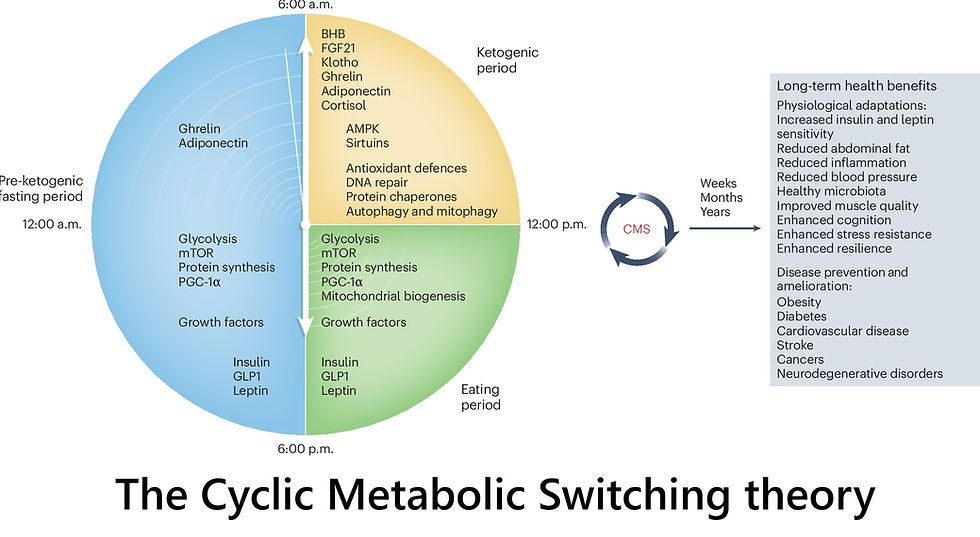
In a new Nature Metabolism perspective, neuroscientist Mark P. Mattson of Johns Hopkins University proposes the Cyclic Metabolic Switching (CMS) theory of intermittent fasting. His thesis is elegant in its simplicity:
The real power of fasting lies not in calorie reduction, but in the rhythmic switching between metabolic stress and recovery.
Just as muscles grow stronger when we alternate effort and rest, our cells gain resilience when they regularly cycle between energy challenge and energy renewal. This oscillation—fasting and feeding, depletion and restoration—is nature’s original healing rhythm.
🧬 Inside the Cellular Metronome
When we fast, the body depletes liver glycogen and begins producing ketone bodies such as β-hydroxybutyrate (BHB). These molecules are not just fuels—they’re signaling messengers that activate adaptive pathways:
AMPK and SIRT1/3 switch the cell into conservation mode, boosting energy efficiency.
Autophagy clears damaged proteins and mitochondria, recycling their components.
NRF2 enhances antioxidant defenses, repairing oxidative damage.
“Fastokines” like FGF21, adiponectin, ghrelin, and α-klotho circulate through the body, promoting tissue repair and metabolic balance.
Then comes the feeding phase. Nutrients reactivate mTOR and PGC-1α, initiating growth, protein synthesis, and mitochondrial biogenesis. Cells rebuild, rewire, and strengthen—preparing for the next wave of stress.
This alternating dance between AMPK ↔ mTOR, autophagy ↔ anabolism, and catabolism ↔ repair forms a cellular rhythm that maintains balance and adaptability across time.
⚙️ The Broader Framework: From CACH to ERM
The Cyclic Metabolic Switching theory aligns with two larger paradigms shaping modern biology:
Calabrese’s Catabolic–Anabolic Cycling Hormesis (CACH)— Health emerges from the rhythm between catabolic stress (breakdown) and anabolic recovery (rebuilding). Too much stress or too little recovery disrupts the cycle and accelerates decline.
Tippairote’s Exposure-Related Malnutrition (ERM) framework— When life’s exposures—psychological, metabolic, or environmental—keep us in “stress mode” without enough substrate or time to recover, our bioenergetic bank account runs dry.The result: cellular exhaustion, inflammation, and early aging.
Together, CMS, CACH, and ERM describe one truth from three angles:
Resilience is rhythmic. Health is cyclical. Disease begins when the rhythm breaks.
⏰ Why Rhythm Matters More Than Restriction
Modern life often erases the natural oscillations our biology depends on. Constant eating, artificial light, stress without rest, and sedentary routines flatten the metabolic waveform. Without fasting, movement, and sleep, our cells never get to complete the
Respond → Adapt → Recover cycle.
Restoring these natural rhythms—through time-restricted eating, consistent sleep, exercise, and periods of metabolic quiet—reactivates the body’s innate timing system. It’s less about willpower and more about allowing oscillation.
🌅 The Takeaway
Fasting, exercise, and sleep are not separate health hacks—they are rhythmic cues that keep the body’s internal metronome in tune.
The new CMS theory doesn’t just explain why intermittent fasting works; it reminds us that life itself is cyclic, and that recovery is as essential as effort.
When we respect that rhythm, we don’t just prevent disease—we restore the flow of resilience that keeps the whole system alive.
Reference:
Mattson, M.P. (2025). The Cyclic Metabolic Switching Theory of Intermittent Fasting. Nature Metabolism.


Comments