
When Adaptation Fails to End: A New Direction in Aging Science

For decades, aging research has largely focused on what goes wrong with time: DNA damage accumulates, mitochondria become less efficient, proteins lose quality control, inflammation becomes persistent, stem cells lose regenerative capacity, and senescent cells accumulate.
The hallmarks of aging framework helped organize these changes into a coherent biological map. But a deeper question is now becoming increasingly important:
Why do these changes persist?
Perhaps aging is not only about accumulating damage. It may also involve something more dynamic—the progressive inability to finish an adaptive response and return to a recovered state.
A recent review in Cell Metabolism provides a particularly interesting example of this shift.
Glucocorticoids: protective first, harmful when adaptation persists
In their 2026 review, Flavia Lambertucci, Frederic Castinetti, Isabelle Martins, Carlos López-Otín, and Guido Kroemer examine the pro-aging effects of chronic glucocorticoid signaling.
This authorship is noteworthy. López-Otín and Kroemer are among the scientists who developed and expanded the hallmarks-of-aging framework. Yet here, the emphasis is not simply on another molecular hallmark. Instead, the review focuses heavily on time, persistence, rhythmicity, adaptation, and recovery.
Glucocorticoids such as cortisol are essential stress hormones. During an acute challenge, they help us survive. They mobilize glucose and lipids, temporarily reduce insulin sensitivity in selected tissues, prioritize fuel for the brain and immune system, control excessive inflammation, and shift cellular priorities away from growth toward immediate survival.
None of this is inherently pathological.
It is adaptation.
The problem emerges when this physiological program does not switch off.
The authors emphasize that normal glucocorticoid biology is highly rhythmic. Cortisol fluctuates across the day and also in shorter ultradian pulses. These periods of activation and withdrawal allow tissues to respond, reset, and remain sensitive to subsequent signals.
When glucocorticoid signaling becomes chronically elevated or temporally flattened, however, the same mechanisms that once protected the organism can progressively undermine it.
This distinction is fundamental:
The biological problem is not necessarily the stress response itself. It is the failure to complete it.
From stress response to persistent adaptation
The glucocorticoid story fits naturally into a simple physiological sequence:
Stress → Respond → Adapt → Recover
A healthy organism must be capable of all four.
The initial response mobilizes resources. Adaptation allows the organism to maintain function while the challenge persists. But once the challenge diminishes, another active biological process must occur: recovery.
Energy allocation must normalize. Immune signaling must resolve. Anabolism must resume. Damaged structures must be repaired or removed. Mitochondrial quality control must recover. Autophagy and proteostasis must again become permissive. Physiological rhythms must be restored.
The Cell Metabolism review suggests what may happen when this final transition becomes incomplete.
Persistent glucocorticoid exposure suppresses or disrupts autophagy, mitochondrial quality control, proteostasis, tissue regeneration and normal nutrient sensing. It promotes insulin resistance, sarcopenia, osteoporosis, immune dysfunction, cardiovascular changes, neurocognitive decline and cellular senescence.
Remarkably, many of these are also recognized features of biological aging.
The authors therefore describe chronic glucocorticoid signaling less as simple toxicity and more as a temporal pathology: an adaptive program that has lost its appropriate timing.
The GC–ACBP/DBI axis: how adaptation can spread into metabolism and behavior
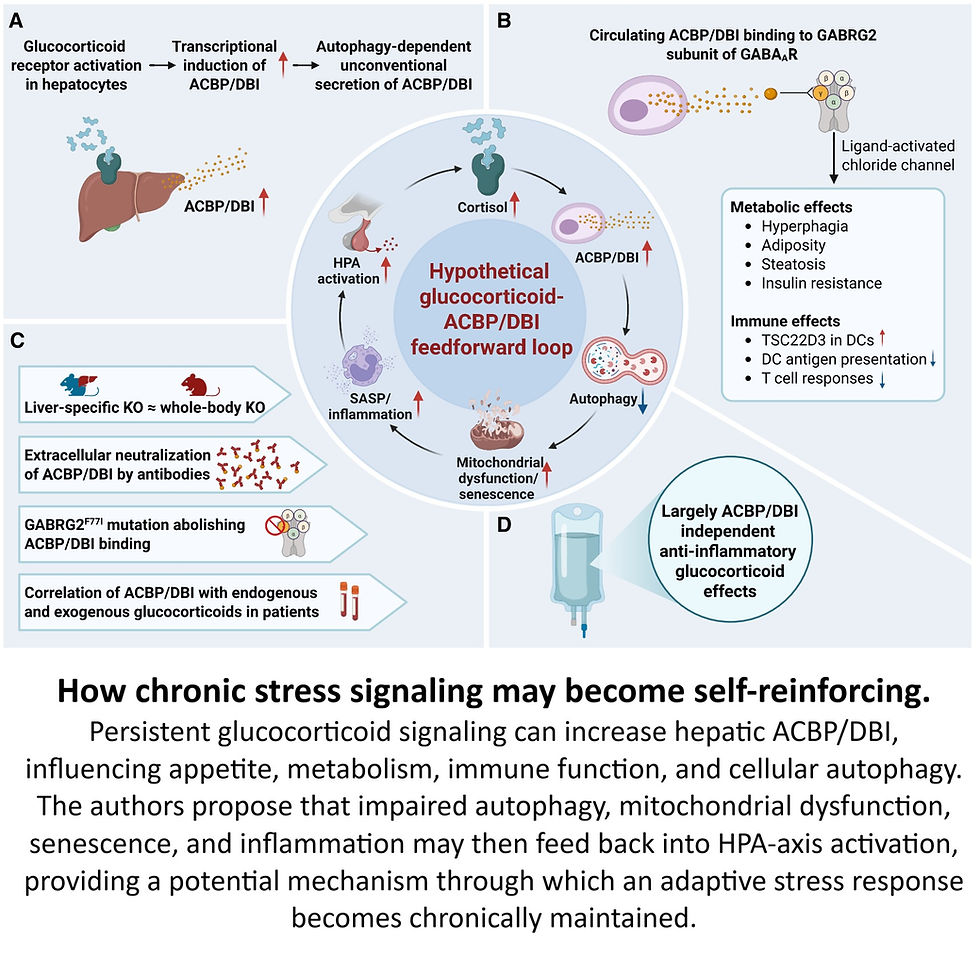
One particularly intriguing mechanism discussed in the review is the glucocorticoid–ACBP/DBI axis.
ACBP/DBI—acyl-CoA-binding protein, also called diazepam-binding inhibitor—is induced by glucocorticoid signaling. The liver appears to be an important source of circulating ACBP/DBI during glucocorticoid exposure.
Once released, ACBP/DBI can influence metabolism, immunity and behavior.
In experimental models, the pathway is associated with increased food intake, adiposity, hepatic steatosis, insulin resistance and altered immune responses. At the cellular level, ACBP/DBI also suppresses macroautophagy, potentially reducing one of the major mechanisms through which cells recycle damaged components and maintain internal quality.
This makes the pathway interesting far beyond endocrinology.
It provides a plausible mechanism connecting:
persistent stress signaling → behavioral change → resource acquisition → metabolic redistribution → reduced cellular maintenance
In other words, chronic adaptation is not confined to a single signaling pathway. The organism can change its behavior, nutrient handling, immune priorities and cellular maintenance programs together.
From an evolutionary perspective, this makes sense.
During a temporary threat, acquiring more energy, preserving circulating substrates and postponing expensive maintenance may be advantageous.
But what happens when the temporary program becomes persistent?
The same resource-allocation strategy that helped the organism survive the short term may gradually become metabolically costly.
When compensation becomes locked in
The review goes one step further by proposing a possible feed-forward loop.
Glucocorticoids increase ACBP/DBI. ACBP/DBI suppresses autophagy. Impaired autophagy contributes to mitochondrial dysfunction and cellular senescence. Senescent cells generate inflammatory signals. Inflammation can then reactivate the hypothalamic-pituitary-adrenal stress system, producing further glucocorticoid signaling.
The authors appropriately describe this loop as a hypothesis requiring further human validation. But conceptually it is important.
It illustrates how an initially adaptive response can gradually become self-maintaining.
The original stressor may no longer be the only thing sustaining the physiology.
The adaptations themselves begin generating conditions that demand further adaptation.
This resembles what we might call compensatory lock-in.
Aging as loss of the ability to return
This perspective also changes how we might think about the hallmarks of aging.
Mitochondrial dysfunction, inflammation, impaired autophagy, altered nutrient sensing, senescence and loss of proteostasis certainly remain important mechanisms.
But perhaps another question should accompany them:
Why did the organism fail to restore these systems after the stress that disturbed them?
That question shifts attention from biological position to biological trajectory.
Two people may have the same fasting glucose, inflammatory marker or mitochondrial measurement today, yet their physiology may be fundamentally different.
One may be moving back toward baseline after a temporary challenge.
The other may be maintaining that same value through progressively greater compensation.
A static measurement cannot necessarily distinguish the two.
Recovery dynamics can.
From hallmarks toward dynamics
This does not mean that aging science is abandoning the hallmarks framework, nor does it mean that a single theory of failed recovery has replaced damage-centered explanations.
But there does appear to be an important change in emphasis.
Increasing attention is being paid to resilience, physiological flexibility, temporal organization, state transitions, maintenance capacity and recovery kinetics.
The glucocorticoid review is particularly illustrative because it shows that the distinction between adaptive and maladaptive biology cannot be made simply by naming the pathway.
The same glucocorticoid signal can be beneficial or harmful.
The difference depends on magnitude, duration, timing, context—and whether the system can recover afterward.
That principle likely extends far beyond cortisol.
The integrated stress response, inflammatory signaling, insulin resistance, mitochondrial remodeling, autophagy, nutrient conservation and neuroendocrine responses can all be protective under the right circumstances.
The critical distinction may therefore be less:
Is this pathway activated?
and increasingly:
Can the organism turn it off when it is no longer needed?
Respond. Adapt. Recover.
A useful way to summarize this emerging view is:
Stress is inevitable. Response is necessary. Adaptation is protective. But recovery determines whether adaptation remains protective.
When recovery succeeds, physiological flexibility is restored and the organism becomes ready for the next challenge.
When recovery is incomplete, residual adaptations remain.
If challenges continue to accumulate before previous adaptations have resolved, compensation may become progressively more persistent. Maintenance can be postponed. Resource allocation can become distorted. The energetic cost of preserving function may increase.
Eventually, what began as an adaptive response may become part of the chronic disease phenotype itself.
This is why the growing scientific interest in recovery capacity may prove important for both aging research and medicine.
Perhaps one of the most useful questions we can ask about aging is therefore not simply:
How much damage has accumulated?
But:
How much capacity remains to recover from it?
Reference
Lambertucci, F., Castinetti, F., Martins, I., López-Otín, C., & Kroemer, G. (2026). Pro-aging effects of chronic glucocorticoid signaling. Cell Metabolism, 38, 1764–1785. https://doi.org/10.1016/j.cmet.2026.05.002


Comments