
When Stress Starts to Stick: ER Stress, the Integrated Stress Response, and the Biology of Resource Allocation

Stress is not automatically harmful. In fact, much of biology depends on the ability to detect a challenge, temporarily redirect resources, and then return toward normal function.
The problem begins when that return never fully happens.
Two recent reviews—one on the integrated stress response (ISR) and another on PERK and endoplasmic reticulum (ER) stress in aging—help explain how this transition may occur at the cellular level. Together, they describe a remarkably coherent sequence: cells sense that demand is exceeding available capacity, reduce expensive activities, prioritize survival and repair, communicate distress to neighboring systems, and either recover or become trapped in a persistent adaptive state.
This cellular biology also provides an important mechanistic foundation for what we have described more broadly as bioenergetic impedance in Network Physiology: a time-dependent constraint that emerges when energetic demand exceeds the capacity to conduct, transform, buffer, and recover the resources needed for biological work.
The ER is more than a protein-folding factory
The endoplasmic reticulum is responsible for producing and processing many of the proteins used by cells and tissues. This makes it extremely sensitive to the balance between workload and available resources.
When protein-folding demand exceeds ER capacity, unfolded or misfolded proteins accumulate. The cell detects this through the unfolded protein response, or UPR, using three major sensors: PERK, IRE1α, and ATF6.
Initially, this is protective.
The cell reduces new protein production, increases chaperones and degradation machinery, adjusts redox balance, and attempts to restore normal ER function. The PERK arm is particularly important because it phosphorylates eIF2α, rapidly slowing global protein synthesis.
This is not simply “shutting the cell down.” It is better understood as resource triage.
Protein synthesis is one of the most energetically expensive cellular processes. Temporarily reducing it allows energy, amino acids, redox capacity, and other resources to be redirected toward functions that are more urgent for survival and recovery. At the same time, selected stress-response proteins such as ATF4 continue to be produced, supporting amino-acid handling, antioxidant defense, autophagy, metabolic adaptation, and organelle quality control.
The cell is therefore making a decision:
What can be postponed, and what must be protected right now?
The integrated stress response expands this logic beyond the ER
PERK is also one of the entry points into the broader integrated stress response.
The ISR integrates several different forms of cellular challenge—including nutrient deprivation, oxidative stress, viral infection, mitochondrial dysfunction, and ER stress—onto a common translational control node involving eIF2α.
The recent “Janus framework” review emphasizes that the acute ISR is normally pulsatile, reversible, and self-limiting. Translation is temporarily restrained, adaptive pathways are selectively activated, and feedback mechanisms then allow normal protein synthesis to resume once the problem has been resolved.
This is a classic adaptive response:
challenge → resource conservation → repair → recovery.
But the same review argues that chronic ISR should not simply be thought of as “acute ISR lasting longer.”
Under unresolved stress, the pathway can become reorganized. Different components may become uncoupled, alternative translational programs emerge, and the cell can enter a new operating state that is no longer simply trying to return to its previous baseline.
That is the “Janus” nature of the pathway: one face supports resilience; the other can support pathological persistence.
The adaptive window
The PERK review adds another useful concept: an adaptive window.
In younger or more resilient cells, a considerable range of stress may still be handled adaptively. PERK/ISR activation lowers workload, restores proteostasis, and permits recovery.
With aging, however, several things change simultaneously. Baseline ER stress rises, oxidative and metabolic stresses accumulate, mitochondrial function becomes less robust, inflammatory signaling increases, and proteostatic reserve declines.
The result is that the adaptive window becomes narrower. The same challenge that could once be resolved may now exceed available capacity and push the system into persistent stress signaling, senescence, inflammation, or cell death.
This concept is closely related to what we refer to as tissue permissiveness.
Permissiveness describes the background capacity of a tissue to support an adaptive response and complete recovery. Adequate substrate availability, mitochondrial capacity, redox buffering, perfusion, nutrient availability, proteostasis, and a supportive local environment all contribute.
In that sense:
permissiveness helps determine the width of the adaptive window.
A highly permissive tissue can absorb a larger challenge without losing recovery capacity. A poorly permissive tissue reaches the threshold of maladaptation much sooner.
When adaptation becomes maladaptation
The important biological boundary is therefore not simply whether a stress response is activated.
Stress responses are supposed to activate.
The more important questions are:
Does the response resolve? Does normal function return? Does the system remain dependent on compensatory signaling after the original challenge has passed?
The ISR review highlights the possibility of hysteresis—a form of biological memory in which the stress-response state persists after stimulus withdrawal or becomes more easily reactivated during a second challenge.
The PERK review reaches a similar conclusion through aging biology. Persistent PERK–eIF2α–ATF4/CHOP signaling can contribute to senescence, apoptosis, inflammatory remodeling, and declining tissue regenerative capacity.
This suggests that maladaptation may involve a progression such as:
temporary compensation → repeated compensation → incomplete recovery → persistent reprogramming → declining reserve.
The machinery that once protected the cell can gradually become part of the problem.
Cellular stress does not stay inside the cell
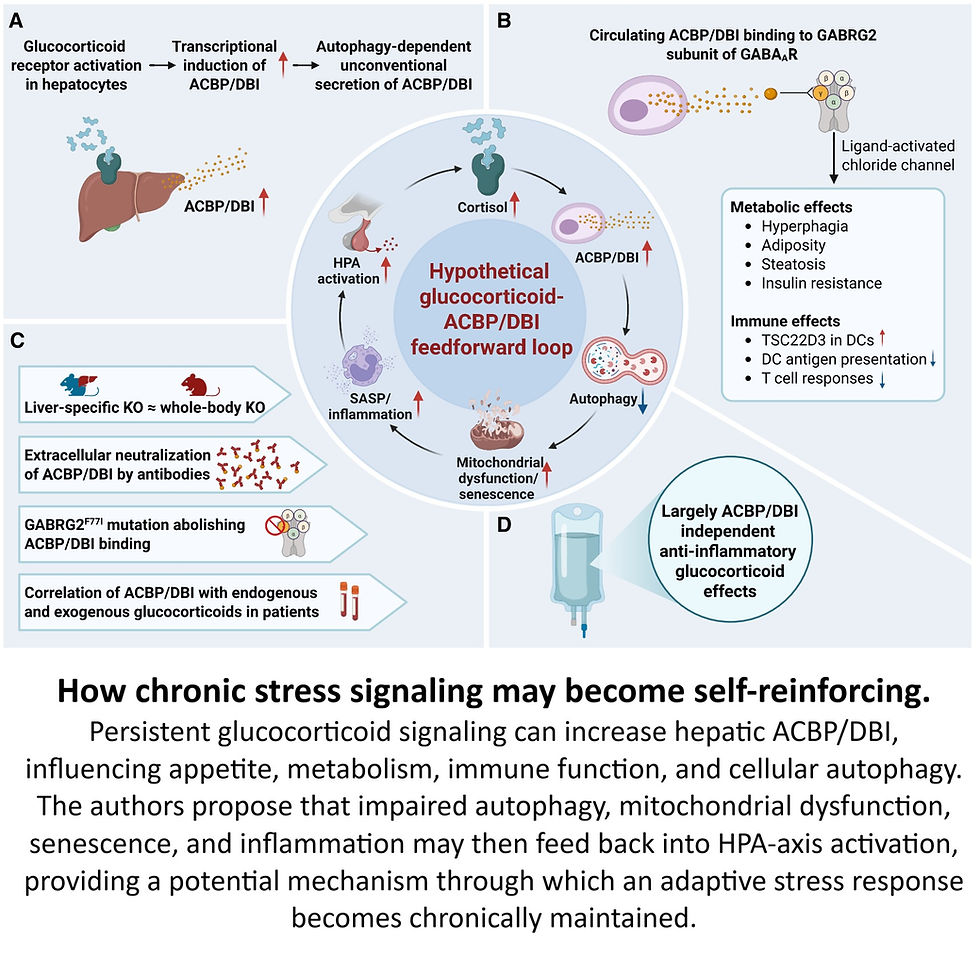
Perhaps the most important implication is that these mechanisms provide routes by which a local energetic problem can become a tissue and eventually systemic event.
Persistent ER stress intersects with immune and inflammatory pathways. The PERK review describes chronic UPR signaling as capable of altering cytokine signaling, antigen presentation, immune-cell behavior, and the senescence-associated secretory phenotype, or SASP. It also highlights a non-canonical cGAS–STING–PERK pathway linking innate immune sensing to translational reprogramming, senescence, and fibrosis.
The ISR review similarly emphasizes that chronic stress responses become intertwined with inflammatory signaling, oxidative stress, mTOR signaling, and other regulatory networks.
This gives us an important bridge:
intracellular resource constraint → stress-response signaling → immune communication → tissue-level adaptation.
Mitochondria provide another communication route. ER and mitochondrial stress systems interact through calcium, reactive oxygen species, mitochondria-associated membranes, and shared ISR/ATF4 signaling. Mitochondrial stress can also generate metabolites, mitochondrial nucleic acids, inflammatory signals, and endocrine stress signals such as mitokines.
Together, these mechanisms create several overlapping channels through which a stressed cell or tissue can communicate its condition to the rest of the organism.
From cellular triage to systemic resource allocation
This is where cellular stress biology begins to meet Network Physiology.
A tissue facing infection, injury, hypoxia, nutrient limitation, or proteotoxic stress cannot simply demand unlimited resources. The organism must decide where energy, substrates, blood flow, immune activity, repair capacity, and behavioral priority should be directed.
Local stress signals therefore participate in a larger allocation problem.
ISR-mediated translational control can reduce expenditure within the cell. Cytokines and innate immune signals can recruit neighboring cells and immune systems. Mitochondrial stress signals and mitokines can influence distant organs. Neuroendocrine and autonomic pathways can subsequently alter appetite, glucose mobilization, vascular tone, activity, sleep, and tissue metabolism.
In other words, the organism does not merely “respond to stress.”
It reprioritizes resources.
That reprioritization is often adaptive. During an acute infection, for example, reduced appetite, altered glucose metabolism, fatigue, immune activation, and behavioral withdrawal may all serve a temporary biological purpose.
But if the underlying constraint does not resolve, the allocation program itself can remain active.
What began as useful triage can become chronic reallocation.
Bioenergetic impedance as the higher-order framework
This is where the concept of bioenergetic impedance becomes useful.
Bioenergetic impedance is not synonymous with ER stress, PERK activation, mitochondrial dysfunction, inflammation, or the ISR.
Those are potential mechanisms, manifestations, and compensatory responses.
The higher-order problem is the mismatch between energetic demand and the capacity to transform and deliver resources into useful biological work—and, crucially, to complete recovery afterward.
Viewed this way:
Bioenergetic constraint activates cellular triage.
UPR and ISR help reorganize intracellular expenditure.
Mitochondrial and immune signals communicate unresolved stress.
Tissues and physiological networks redistribute resources.
Recovery restores flexibility—or unresolved stress stabilizes the compensatory state.
This provides a mechanistic route from cellular stress adaptation to network-level reorganization.
The idea is not that “impedance” physically travels from one organ to another. What propagates are signals about constraint and instructions for resource reallocation.
Recovery may be the most important variable
Both reviews ultimately point toward a broader principle.
The distinction between healthy adaptation and pathology may depend less on whether a stress pathway becomes activated than on whether the system can subsequently turn it off.
PERK activation can be protective or harmful. ISR activation can preserve survival or support disease. Senescence itself can assist wound healing or contribute to chronic degeneration.
Context matters. Intensity matters. Timing matters.
But above all, reversibility matters.
This is why recovery deserves to be treated as an active biological process rather than simply the absence of stress.
A resilient system can temporarily reprioritize resources, solve the problem, and restore normal allocation.
A vulnerable system may continue compensating long after the initial challenge, progressively narrowing its adaptive window and increasing the cost of subsequent stress.
That may be one of the most important ways to understand the transition from adaptation to chronic disease:
stress is inevitable; persistent resource triage is not.
References:
Altintas, D. M., Cerqua, M., Comoglio, P. M., & Chaveroux, C. (2025). The Janus framework of the integrated stress response: From homeostasis to maladaptation. Life Science Alliance, 9(3), e202503523. https://doi.org/10.26508/lsa.202503523
Pandey, V., Sachdeva, R., & Despa, S. (2026). The PERK paradox in aging: How ER stress shapes senescence and neurodegeneration. GeroScience. Advance online publication. https://doi.org/10.1007/s11357-026-02430-5


Comments