
When “Wellness” Turns Risky
- Healing_ Passion
- Nov 15, 2025
- 3 min read

What a New Case Report Reveals About Ozone Therapy and Hidden Heart Anatomy
A new case report published in Archives of Academic Emergency Medicine describes a frightening neurological crisis that unfolded minutes after a young woman received an intravenous ozone treatment— a procedure that has become increasingly popular in anti-aging and “immune-boosting” clinics around the world.
Ozone therapy is often promoted as a natural, regenerative, or detoxifying intervention. But the science behind these claims remains weak, and the safety concerns are very real. This case provides one of the clearest warnings yet.
A Healthy 36-Year-Old… Until an Ozone Infusion Triggered a Neurological Catastrophe
In the reported case, a previously healthy woman received 150 mL of ozone-infused blood during a routine outpatient wellness session meant to “boost immunity.”
Within minutes, she developed:
sudden chest pain,
loss of consciousness,
a generalized seizure, and
severe confusion.
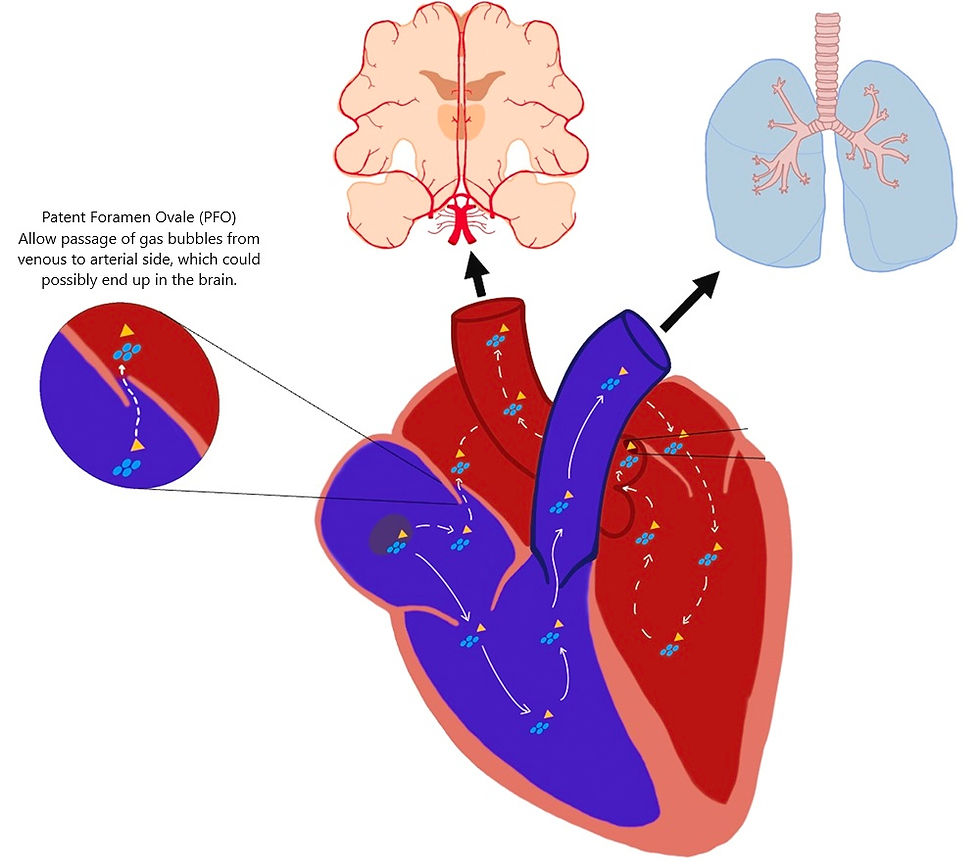
Imaging later revealed multiple ischemic infarcts—strokes— scattered across her thalamus, cerebellum, temporal lobes, and occipital lobes. The damage pattern was consistent with a gas embolism, meaning bubbles had entered her bloodstream and traveled to her brain.
She survived but experienced persistent cognitive problems—memory issues, attention deficits, and migraines—for many months afterward.
This was not a stroke caused by cholesterol plaques or clots.
This was a stroke caused by gas entering the arterial circulation.
But how does gas injected into a vein end up in the brain?
This is where an important piece of hidden anatomy comes in.
The Silent Anatomy: Patent Foramen Ovale (PFO)
A Patent Foramen Ovale is a tiny flap-like opening between the upper chambers of the heart
You probably don’t know if you have one.
But one in four adults does.
In most people, a PFO never causes symptoms.
But if gas bubbles enter the venous circulation—through an IV line, an injection, or a wellness treatment using gas—it becomes a dangerous shortcut.
Normally, the lungs act as a filter for venous air.
But with a PFO, venous gas can cross into the arterial circulation—and from there, straight to the brain.
This is called a paradoxical embolism, and it is exactly what appears to have happened in the ozone therapy case.
The patient was later found to have a small PFO, which likely enabled gas bubbles from the ozone infusion to bypass the lungs and lodge in multiple brain regions, causing widespread ischemic injury.
The Alarming Trend: Ozone Therapy in Anti-Aging Clinics
Ozone therapy is becoming more common in:
wellness centers
anti-aging clinics
IV lounges
regenerative medicine practices
It is marketed as:
anti-inflammatory
immune-boosting
anti-aging
detoxifying
But none of these claims are supported by robust evidence, and major regulatory agencies—including the U.S. FDA—explicitly warn against ozone therapy due to its toxic properties and lack of proven benefit.
Meanwhile, the procedure introduces gas directly into the bloodstream, an action that requires medical training, precision, and strict safety controls—yet is often administered in non-medical settings or with minimal oversight.
This creates a perfect storm:
25% of people have a PFO
Ozone therapy involves gas infusion
Many clinics lack monitoring, protocols, or emergency preparedness
That combination should concern everyone.
Why This Matters for Public Health
The convergence of two facts:
PFO is extremely common, and
IV ozone therapy is rapidly expanding in anti-aging practices,
represents a silent but significant public health risk.
Most people with a PFO will never know they have one.
But if they undergo a therapy that introduces gas into the bloodstream, the risk of a paradoxical embolism—and potentially devastating neurological injury—rises sharply.
The case report is not just a medical curiosity.
It is a warning.
A Better Path to Healthy Aging
Healthy aging does not come from unproven and potentially risky interventions.It comes from:
metabolic health
nutrient sufficiency
circadian rhythm alignment
cardiovascular fitness
stress regulation
personalized nutrition
high-quality sleep
evidence-based therapeutics and diagnostics
The philosophy that drives many people toward ozone therapy—seeking vitality, resilience, and prevention—is valid.
The intervention, however, is not.
Final Thoughts
This case is a stark reminder that:
“Alternative” does not mean “safe.”
“Natural” does not mean “risk-free.”
And common anatomical variations like PFO can turn a routine wellness treatment into a life-changing emergency.
As ozone therapy continues to spread through anti-aging and wellness circles, clinicians, policymakers, and the public must recognize the very real risks—especially for the millions of people with an undiagnosed PFO.
Safety must always come before trends.
Wong, C. Y. Y., Saxena, K., Meneer, J., George, K., & Keijzers, G. (2025). Neurological crisis following intravenous ozone therapy: A case report. Archives of Academic Emergency Medicine, 13(1), e31. https://doi.org/10.22037/aaemj.v13i1.2592


Comments